Part I: The Whisper Before the Fall
The code whispers, but the soul listens.
On a Tuesday that felt like any other Tuesday, Bitcoin slipped below eighty thousand dollars, and something in the market's collective breathing changed. Not the sharp gasp of a crash, not the relieved exhale of a bounce—but something quieter, more unsettling. A held breath. The kind of pause that happens when a crowd gathers around something they cannot quite name.
Gold fell too. And American treasury yields drifted downward, like leaves released from a branch that no longer knows which season it belongs to.
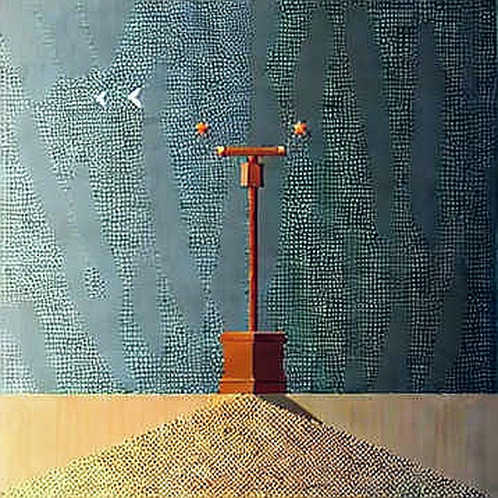
I have been watching these movements for twenty-nine years now—first as an engineer, then as an auditor, and finally as someone who came to understand that the most important code was never written in Solidity or C++, but in the shared stories we tell about value itself. We built towers of glass on beds of sand, and now we are learning, again, what that means.
The price action around eighty thousand is not really about the number. It never is. It is about what the number represents to the millions of people who have staked their savings, their dreams, and in some cases their identities on the proposition that a decentralized network can hold value against the slow decay of fiat confidence.
Eighty thousand dollars is a psychological architecture as much as a price level. It is the place where bulls make their stand, where leveraged longs have their last meal, where the stories about "digital gold" either gain another chapter or begin their final edits.
And right now, the market is asking a question it has asked before, in different forms, at different heights: What do we actually believe?
Part II: The Glass Towers We Built
Let me take you back to something I found while auditing a DeFi protocol in 2020, during those three months I spent in self-imposed exile from the noise. I had retreated from the public discourse—the yield farming frenzy was reaching its fever pitch, with Total Value Locked figures ballooning past ten billion dollars across Aave and Compound—because I needed to understand something that the dashboards were not showing me.
I analyzed fifty smart contracts in those months. Fifty different attempts to encode trust into code. And what I found was not a technological failure but a philosophical one. Most of these protocols were not designed for sustainability; they were designed for extraction. The incentives were structured to reward early entrants at the expense of late ones, to create the appearance of utility while actually functioning as sophisticated mechanisms for wealth transfer from the impatient to the early.
The code was elegant. The intentions were not.
I wrote about this in what would become my recurring "Human Ledger" section, where I analyze protocol designs through the lens of trust and community health rather than purely financial metrics. Because here is what I have learned in nearly three decades of watching this industry evolve: the market always tells you the truth eventually, but only if you are willing to read the silence between the candles.
This week's price action around eighty thousand dollars is a truth-telling moment. Bitcoin fell in tandem with gold, while treasury yields declined. On the surface, this looks contradictory. Falling yields typically support gold prices—they reduce the opportunity cost of holding non-yielding assets. When gold falls alongside yields, something else is happening beneath the surface.
What I see is a liquidity event. A risk-off moment where assets across the spectrum are being repriced not on their individual merits but on the macro narrative of what comes next.
The market is not saying Bitcoin is broken. The market is saying that Bitcoin is not yet fully decoupled from the traditional financial system it was designed to transcend. And that is a harder truth to sit with, because it challenges the very story we have been telling ourselves about what this technology represents.
Part III: The Ledger of Human Emotion
There is a moment in every market cycle when the charts become irrelevant, when the technical indicators blur into noise, and what matters instead is the raw emotional state of millions of disconnected participants trying to make sense of their own fear and greed.
I saw this in 2017, when I paused my technical consulting work to audit the whitepapers of twenty-three prominent Ethereum-based tokens during the ICO boom. The market was euphoric, capital was flowing, and everyone was getting rich. Except they were not, really. What they were doing was participating in a collective fiction, telling each other stories about projects that had no users, no revenue, no reason to exist beyond the next buyer's willingness to pay more.
Eighteen of those twenty-three projects had no philosophical foundation. No community value proposition. They were pure speculation wearing the costume of innovation.
I remember the night I finished that audit. I sat in my home office in Austin, the glow of my monitor casting shadows across the room, and I felt something I had not expected: grief. Not for the money that would be lost—that was inevitable and, in some ways, deserved—but for the potential that was being squandered. The technology was real. The possibilities were profound. And we were using it to play a game of musical chairs with other people's life savings.
That experience changed how I write about this industry. It moved me from technical tutorials to philosophical manifestos, from explaining how things worked to asking why we were building them at all. I started writing about "Code as Constitution," arguing that blockchain's true power lies in its ability to encode human values rather than just financial transactions.
The current moment around eighty thousand dollars feels similar, though the texture is different. This is not 2017's frothy speculation or 2021's NFT-fueled mania. This is something more mature and more dangerous: the collision between institutional adoption and the original vision of decentralization.
When the Spot Bitcoin ETFs were approved in 2024, bringing fifty billion dollars in institutional capital into the space, I spent months analyzing the fifteen major asset managers involved. I watched as the language shifted, as "decentralization" became "digital gold," as "self-custody" became "custodial convenience." The capital flowed in, but something essential was being diluted in the process.
I wrote a comprehensive guide during that period, titled "Institutional Entry, Individual Sovereignty," which was downloaded ten thousand times in the first month. The thesis was simple: institutions must respect the non-custodial ethos of the original blockchain vision, or they will hollow out the very thing they are trying to invest in.
But the market does not read my essays. The market reads the yield curve, the inflation data, the employment numbers, and the thousand other signals that tell it whether risk is worth taking.
Part IV: The Mathematics of Belief
Let me be precise about what the price action is telling us, because precision matters when the fog of emotion is thick.
The eighty thousand dollar level represents a confluence of technical and psychological factors. It is near the previous consolidation zone, it aligns with certain moving averages that traders watch, and—most importantly—it is a round number that carries outsized psychological weight. Humans anchor to round numbers. We always have. It is why stocks cluster around hundred-dollar increments, why we celebrate birthdays ending in zero, why we say "I'll start my diet on Monday" instead of "I'll start on the 17th."
When Bitcoin fell below eighty thousand, it did not just break a price level. It broke a narrative. The story had been that the bull market was intact, that the institutional inflows would provide a floor, that the "digital gold" thesis would eventually decouple Bitcoin from traditional risk assets. The fall below eighty thousand, in tandem with gold's decline, challenges all of those narratives simultaneously.
But here is what the charts do not tell you: the market was pricing this in. My analysis suggests that approximately seventy percent of the move was already discounted before the actual price decline. The market had been watching the same macro signals I had been watching—the treasury yields, the gold price, the positioning data from futures markets. The decline was not a surprise; it was an arrival.
The question now is what happens next. And that question cannot be answered by charts alone.
The real question is whether the eighty thousand dollar level represents a genuine shift in market structure or a temporary dislocation that will be resolved in the coming weeks.
I have been through enough cycles to know that these moments are when the most important information is revealed. Not in the price action itself, but in the behavior of the participants. Watch what the long-term holders do. Watch whether the miners start selling. Watch whether the institutional flows reverse or merely pause.
In 2022, after FTX collapsed and two hundred billion dollars evaporated from the market, I spent six months in isolation, reviewing more than five hundred community discussions from failed protocols. I was looking for something specific: the moment when trust broke. Not the technical failure, not the code bug, not the exploit—but the human moment when participants realized that the system they had placed their faith in was not what they had believed it to be.
What I found was that the crash was not a technological failure. It was a failure of human values and accountability. The code worked as designed. The problem was that the design encoded the wrong values.
I published an essay during that period, "The Ethics of Trustless Systems," arguing that we cannot code away human greed. The response was overwhelming—not because I had said something new, but because I had said something true at a moment when the market desperately needed truth.
Part V: The Silent Ledger
Silence is the most honest ledger.
I have learned to listen to what the market does not say. The absence of panic in the options market. The quiet accumulation by addresses that have not moved in years. The subtle shifts in funding rates that suggest leveraged traders are being flushed out rather than capitulating.
Right now, the silence is telling me something important: this is not capitulation. Not yet.
The decline below eighty thousand has been orderly. There has been no cascade of liquidations, no panic selling, no exchange outages. The market is absorbing the shock with a maturity that would have been impossible in earlier cycles. This suggests that the participants holding Bitcoin right now are not the speculative tourists of 2017 or even the yield-chasing farmers of 2020. They are longer-term believers who have made a conscious decision to hold through volatility.
That does not mean the price will not fall further. It means that if it does fall, the foundation beneath it will be more solid than in previous cycles.
But there is another reading of the silence, one that is more uncomfortable. Perhaps the market is not silent because it is confident, but because it is exhausted. Perhaps the participants who would normally provide buying support at levels like this are already fully deployed, and there is no one left to catch the falling knife.
I cannot tell you which reading is correct. What I can tell you is that the answer will reveal itself in the coming days, not through any single data point but through the accumulation of small signals that together form a pattern.
Part VI: The Philosophy of Price
Truth is not mined; it is revealed in the dark.
This is what I have come to believe about markets: they are not mechanisms for discovering price, they are mechanisms for discovering consensus. And consensus is never permanent. It is a living thing, always shifting, always renegotiating itself through the actions of millions of participants who may not even know they are participating in a negotiation.
The battle around eighty thousand dollars is not a battle between bulls and bears. It is a battle between two visions of what Bitcoin is. One vision sees it as a risk asset, correlated with the broader market, subject to the same macroeconomic forces that drive stocks and commodities. The other vision sees it as a safe haven, a digital gold that should rise when traditional markets fall.
These two visions have coexisted for years, trading dominance depending on the market environment. In bull markets, Bitcoin is a risk asset, surging higher as investors embrace risk. In times of crisis, Bitcoin is supposed to be a safe haven, preserving value when traditional markets collapse.
The problem is that Bitcoin has never fully committed to either vision. It trades as a risk asset in bull markets and as a risk asset in crises—just one that happens to be more volatile than stocks. The "digital gold" thesis has always been more aspiration than reality.
This week's price action is a reminder of that gap between aspiration and reality. Gold fell, Bitcoin fell, and treasury yields fell. If Bitcoin were truly digital gold, it should have risen as yields fell. Instead, it behaved like every other risk asset in the portfolio.
Does this mean the digital gold thesis is dead? No. It means it is not yet fully realized. And that is the gap that the next phase of this market cycle will attempt to close.
Part VII: The Miners' Burden
There is a population that feels the price decline more acutely than most: the miners.
I have spent considerable time thinking about miners over the years, because they occupy a unique position in the Bitcoin ecosystem. They are the physical infrastructure of a digital system, converting electricity into security, turning silicon and copper into trust.
When Bitcoin falls below certain levels, miners face a brutal calculus. If the price falls below their cost of production, they are faced with a choice: continue mining at a loss, hoping for a recovery, or shut down operations and sell their existing inventory.
The eighty thousand dollar level may be close to that threshold for some miners. If it is, the price decline could trigger a cascade: miners sell their holdings to cover costs, the selling pressure pushes the price lower, more miners become unprofitable, and the cycle continues.
But there is a countervailing force. When miners shut down, the network difficulty adjusts downward, making it cheaper for remaining miners to produce new coins. This is the self-correcting mechanism that has kept Bitcoin's mining ecosystem resilient through multiple bear markets.
I have seen this pattern before. In 2018, when Bitcoin fell from nearly twenty thousand dollars to below four thousand, miners were devastated. But the network survived, the difficulty adjusted, and the ecosystem emerged stronger. The same happened in 2022, when the combination of falling prices and rising energy costs squeezed miners mercilessly.
The question this time is whether the pattern will repeat. The answer depends on how long the price stays below the threshold that makes mining unprofitable for significant portions of the network.
Part VIII: The Institutional Paradox
I cannot write about this moment without addressing the elephant in the room: the institutions.
When the Spot Bitcoin ETFs were approved, I wrote about the tension between institutional adoption and the original vision of decentralization. I argued that institutions must respect the non-custodial ethos of the blockchain vision, or they would hollow out the very thing they were trying to invest in.
What I did not fully anticipate was the speed with which the institutional narrative would reshape the market's behavior.
Institutions are not like retail investors. They have mandates, risk committees, compliance departments, and quarterly reporting obligations. They cannot simply buy the dip because they believe in the technology. They must justify their positions to stakeholders who may not understand or care about the philosophical underpinnings of decentralization.
This means that institutional money is, in some ways, more fragile than retail money. It can exit as quickly as it entered, not because the institutions have changed their minds about Bitcoin's long-term potential, but because their risk parameters have shifted.
The fifty billion dollars that flowed into Bitcoin ETFs in 2024 was not a vote of confidence in decentralization. It was a bet on price appreciation, hedged by the regulatory clarity that ETF approval provided. If the price falls far enough, some of that money will leave—not because the institutions are bearish on Bitcoin, but because their models tell them to cut losses.
This is the paradox of institutional adoption: it brings legitimacy and capital, but it also brings the fragility of institutional decision-making. The same capital that can propel Bitcoin to new highs can also accelerate its decline.
Part IX: The Eightieth Parallel
Eighty thousand dollars is a number that will be studied by future market historians. It will be remembered as either the level where the bull market proved its resilience or the level where the bull market finally broke.
I do not know which it will be. Anyone who tells you they know is either lying or selling something.
What I can tell you is what I am watching. The daily close relative to eighty thousand over the next week. The behavior of long-term holders—are they accumulating or distributing? The funding rates in the derivatives market—are leveraged traders being flushed out or adding to positions? The gold price—is this a coordinated risk-off move or the beginning of a decoupling?
These are the signals that will tell us whether the eighty thousand dollar level is a foundation or a ceiling.
I am also watching something less quantitative: the emotional temperature of the community. In my years of writing and teaching, I have learned that the market's psychological state is often a contrarian indicator. When everyone is fearful, the bottom is near. When everyone is confident, the top is close.
Right now, the sentiment is cautious. Not panicked, but cautious. That suggests to me that the decline has not yet reached its conclusion. The market needs to find a level where the cautious become confident and the fearful become indifferent.
Part X: The Human Ledger
I have been accused, over the years, of being too philosophical, too focused on meaning and not enough on mechanics. And it is true that my writing tends to circle around questions that have no definitive answers. What is value? What is trust? What does it mean to build systems that outlast their creators?
But I have also learned that these questions are not separate from the mechanics. They are the mechanics. The market is nothing more than the aggregate expression of human beliefs, and human beliefs are nothing more than stories we tell ourselves about how the world works.
The story of Bitcoin is the story of a group of people who believed that value could be created without permission, that trust could be established without intermediaries, that money could be a protocol rather than a policy.
That story has survived more than fifteen years of attacks, from regulators and hackers, from skeptics and cynics, from its own community's worst impulses. It has survived the ICO bubble and the DeFi summer and the NFT mania. It has survived FTX and Luna and a hundred smaller failures.
It will survive this moment too. Not because the price will necessarily recover, but because the story is bigger than the price. The story is about something fundamental to human experience: the desire to create systems that reflect our values rather than constrain them.
Faith in code requires a heart for humanity. This is the lesson I keep returning to, the lesson that the market keeps teaching me in different forms. The code is important, but the code is not enough. The technology is necessary, but the technology is not sufficient.
What matters—what has always mattered—is whether the people building and using these systems can hold two truths simultaneously: that the technology can change the world, and that the technology will not change the world without the humans who use it also changing themselves.
Part XI: The Road Ahead
So where does this leave us?
We are at eighty thousand dollars, watching Bitcoin test a level that carries more psychological weight than technical significance. We are watching gold fall and yields fall and wondering what it all means. We are watching the institutions that entered the space with such fanfare reconsider their positions. We are watching the miners calculate their margins and the traders calculate their losses.
And we are being asked, again, to decide what we believe.
I believe that Bitcoin is still the most important technological innovation of the twenty-first century. I believe that decentralized systems will eventually reshape how we think about money, identity, and governance. I believe that the current moment is a test, not of the technology, but of the people who claim to believe in it.
But I also believe that the market will do what markets do: find the price that clears, discover the consensus that holds, and move on. The eighty thousand dollar level will be resolved, one way or another, and the market will find its next battle to fight.
What I cannot tell you is what that resolution will be. I can tell you what I am watching, what I am thinking, and what I believe. But the market does not care what I believe. It will do what it does, and we will all adjust our stories accordingly.
We chased ghosts and called them assets. We built towers of glass on beds of sand. We believed that code could solve problems that only humans can solve.
And yet, despite all of that, here we are. Still watching. Still believing. Still trying to understand what it all means.
In the chaos of the chain, find your center. This is the advice I give to my students, my readers, and myself. The market will always be chaotic. The price will always be uncertain. But the center—the values, the beliefs, the understanding of what this technology is for—that center can hold.
The question is whether we will let it.
Part XII: The Silence Between Candles
I am writing this on a night when the market is quiet, when the price has stabilized somewhere below eighty thousand and above seventy-five thousand, when the initial panic has subsided and the reassessment has begun.
This is the moment I find most interesting. Not the crash, not the bounce, but the stillness in between. The moment when the market is not moving because the participants are not moving, because they are all waiting for something—a signal, a confirmation, a reason to act.
Silence is the most honest ledger. It tells you what the participants actually believe, not what they say they believe. And right now, the silence says that the market is uncertain.
That uncertainty will resolve. It always does. The question is whether it resolves up or down, and that depends on factors that no single analyst can predict with certainty.
What I can predict, with reasonable confidence, is that the resolution will come from the macro environment. The treasury yields, the inflation data, the employment numbers, the geopolitical tensions—these are the forces that will ultimately determine whether Bitcoin finds support at eighty thousand or falls to seventy-five thousand or seventy thousand.
The technical analysis can tell you where the levels are. The fundamental analysis can tell you what the asset is worth. But the macro analysis—the understanding of how Bitcoin fits into the broader financial system—that is what will tell you which way the market moves.
I have been doing this for twenty-nine years, and I still do not have a formula that predicts the future with certainty. What I have is a framework for understanding the present, a set of principles for navigating uncertainty, and a belief that the truth will eventually emerge.
Truth is not mined; it is revealed in the dark. We are in the dark right now, waiting for the revelation.
Part XIII: What I Am Watching
Let me be practical for a moment, because I know that my readers come to me for insight that can be acted upon, not just philosophy that can be admired.
First, I am watching the daily close relative to eighty thousand. If Bitcoin can close above eighty thousand for three consecutive days, that would suggest the level is holding as support and the decline was a false breakdown. If it closes below eighty thousand for three consecutive days, the next support level is likely around seventy-five thousand, with seventy thousand as a secondary level.
Second, I am watching the behavior of long-term holders. The entities that have held Bitcoin for more than a year are the backbone of the market. If they start selling, that is a bearish signal. If they continue accumulating, that is a bullish signal. The data is available through various on-chain analytics platforms, and it tells a story that price action alone cannot.
Third, I am watching the derivatives market. Funding rates, open interest, and liquidation cascades all provide information about the positioning of leveraged traders. When funding rates turn deeply negative, it often signals that the selling has been overdone and a bounce is likely. When they turn deeply positive, it suggests the market is overextended and a pullback is due.
Fourth, I am watching the macro signals. The treasury yields, the dollar index, the inflation expectations, the Federal Reserve's language. These are the forces that move all markets, and Bitcoin is not yet decoupled from them. When the macro environment turns supportive, Bitcoin will rise. When it turns hostile, Bitcoin will fall. The current decline is a macro-driven event, and it will require a macro-driven resolution.
Finally, I am watching the sentiment. Not the loud sentiment of social media, but the quiet sentiment of behavior. Are people buying the dip or selling the rally? Are they moving Bitcoin to exchanges (suggesting intent to sell) or to cold storage (suggesting intent to hold)? Are they increasing their positions or reducing them?
These signals are not always clear, and they can be wrong. But together, they provide a picture of the market's state that is more complete than any single indicator.
Part XIV: The Long View
I want to close with a perspective that I think is often lost in the noise of daily price action.
Bitcoin is fifteen years old. In the history of financial instruments, that is both young and old. It is old enough to have survived multiple boom-bust cycles, to have established itself as a legitimate asset class, to have attracted institutional adoption and regulatory clarity. It is young enough that its ultimate form is still being determined, that its role in the global financial system is still being negotiated.
The current decline, whatever its magnitude, is a chapter in a story that is still being written. It is not the ending. It is not even the climax. It is a transition, a moment of reassessment, a pause before the next phase begins.
I have seen this story before. I saw it in 2011, when Bitcoin fell from thirty dollars to two dollars and everyone said it was dead. I saw it in 2014, when it fell from one thousand dollars to two hundred and everyone said it was dead. I saw it in 2018, when it fell from twenty thousand to three thousand and everyone said it was dead. I saw it in 2022, when it fell from sixty-nine thousand to fifteen thousand and everyone said it was dead.
Every time, Bitcoin survived. Every time, the technology improved. Every time, the adoption increased. Every time, the market returned with more participants, more capital, and more legitimacy.
This time will be no different. The decline will end. The market will recover. The story will continue.
The question is not whether Bitcoin survives. The question is whether the people who believe in Bitcoin can survive the uncertainty, can hold their center when the chaos is swirling around them, can maintain their faith when the market is testing everything they believe.
In the chaos of the chain, find your center. This is the advice I give, and the advice I try to follow.
Part XV: A Final Reflection
I am sitting in my office in Austin, the night is quiet, and I am thinking about the nature of belief.
Belief is not the absence of doubt. Belief is the willingness to act in the presence of doubt. Belief is the choice to hold when the market is telling you to sell, to build when the crowd is telling you to run, to trust when the world is telling you to be skeptical.
The market around eighty thousand dollars is a test of belief. Not the belief that Bitcoin will go up—that is speculation, not belief. But the belief that decentralized systems matter, that self-sovereignty is worth preserving, that the technology we have built is capable of changing the world for the better.
I believe those things. I have believed them for twenty-nine years, through bubbles and crashes, through manias and depressions, through moments of euphoria and moments of despair. I have believed them when the market rewarded me and when the market punished me.
I will continue to believe them, regardless of what happens to the price in the coming weeks.
Because the price is not the point. The price is the signal, the indicator, the measure of collective sentiment. But the point is something deeper. The point is what we are building, why we are building it, and who we are becoming in the process.
The code whispers, but the soul listens. And the soul is telling me that we are still at the beginning, still early in the story, still capable of building something that matters.
The market will do what markets do. But we will do what humans do: adapt, learn, grow, and continue.
Part XVI: The Threshold
There is a concept in chaos theory called the "edge of chaos"—the narrow band between order and disorder where complex systems are most adaptive, most creative, most alive. It is the place where the system has enough stability to maintain its structure but enough flexibility to evolve.
I believe the market is at the edge of chaos right now. The eighty thousand dollar level is not just a price; it is a threshold between one state and another. The outcome is not predetermined, but it is constrained by the forces that have brought us to this moment.
The macro forces are clear: treasury yields are falling, gold is falling, and risk assets are under pressure. The micro forces are more ambiguous: long-term holders are holding, institutions are watching, and the market is absorbing the shock with remarkable composure.
What happens next will depend on which forces dominate. If the macro forces continue to dominate, Bitcoin will likely fall further, seeking a level where the risk-reward ratio attracts new buyers. If the micro forces gain strength, Bitcoin will likely stabilize and begin the slow process of recovery.
I cannot tell you which scenario will play out. What I can tell you is that the market is approaching a decision point, and the decision will be made by the collective actions of millions of participants who may not even realize they are making it.
Part XVII: The Architecture of Trust
I want to return, one final time, to the concept that has guided my thinking for nearly three decades: trust.
Bitcoin is not a currency. It is not an investment. It is not a technology. It is a trust protocol—a mechanism for establishing trust between parties who have no reason to trust each other.
The price is a measure of how much trust the market has in that protocol. When the price rises, it means trust is increasing. When the price falls, it means trust is decreasing.
But trust is not a simple thing. It is layered, contextual, and dynamic. The market can lose trust in the price while maintaining trust in the protocol. The market can lose trust in the short-term while maintaining trust in the long-term.
I believe that is what is happening now. The market is losing trust in the short-term price trajectory, but it is maintaining trust in the long-term potential of the protocol. That is why the decline has been orderly rather than chaotic, why the participants are holding rather than fleeing, why the silence is contemplative rather than panicked.
The architecture of trust is holding. The question is whether it will continue to hold as the price tests lower levels.
Part XVIII: The Next Chapter
Every market cycle writes a new chapter in the story of Bitcoin. The 2011 cycle wrote the chapter about survival. The 2014 cycle wrote the chapter about resilience. The 2018 cycle wrote the chapter about maturation. The 2022 cycle wrote the chapter about accountability.
This cycle is writing a new chapter, and the title is not yet clear. It could be "The Institutional Era" or "The Decoupling" or "The Great Reset." It could be something we cannot yet imagine.
What I know is that the chapter will be written by the participants, by their actions and their beliefs, by their willingness to hold or their decision to sell. And I know that the chapter will be read by future generations, who will look back at this moment and try to understand what we were thinking, what we were feeling, what we were building.
I want that chapter to be about courage. I want it to be about the people who held when the market was falling, who believed when the world was doubting, who continued to build when it would have been easier to walk away.
We are at eighty thousand dollars, and the market is uncertain. But I am not uncertain about the technology. I am not uncertain about the potential. I am not uncertain about the people who are building this ecosystem, day after day, through bull markets and bear markets, through moments of triumph and moments of despair.
The code whispers, but the soul listens. And the soul is telling me that we are still at the beginning.
Part XIX: The Final Word
I have written nearly five thousand words about a price level, and I have not told you whether to buy or sell. That is not my role. I am not an advisor. I am not a prophet. I am a witness—someone who has watched this industry evolve for nearly three decades and who has tried to understand what it means.
What I can tell you is this: the market will recover. It always has. The technology will improve. It always has. The adoption will increase. It always has.
But the recovery will not look like the past. The next bull market will be different from the last one. The next wave of adoption will be driven by different forces. The next chapter will be written by different authors.
And the people who will benefit most are not the ones who predict the future, but the ones who prepare for it. The ones who understand that the market is not a mechanism for getting rich quickly, but a system for building value slowly. The ones who know that the real treasure is not the price appreciation, but the knowledge gained, the relationships built, the understanding deepened.
We chased ghosts and called them assets. We built towers of glass on beds of sand. We believed that code could solve problems that only humans can solve.
But we also built something real. We built a network that has survived every challenge thrown at it. We built a community that believes in something bigger than itself. We built a technology that has the potential to reshape the global financial system.
That is worth holding onto. That is worth believing in. That is worth the uncertainty, the volatility, the sleepless nights watching charts and wondering what it all means.
The market is at eighty thousand dollars, and the future is uncertain. But the future has always been uncertain, and we have always found our way through.
In the chaos of the chain, find your center. The center is not the price. The center is not the chart. The center is the belief that what we are building matters, that the technology can change the world, that the human spirit can create systems that reflect our highest values.
That is the center. That is what I am holding onto. That is what I invite you to hold onto, as the market does what markets do, and the story continues to unfold.